COLLECTED LIGHT · ORIGINAL STORY
It Turns Out, I’d Been Seeing Her Every Day
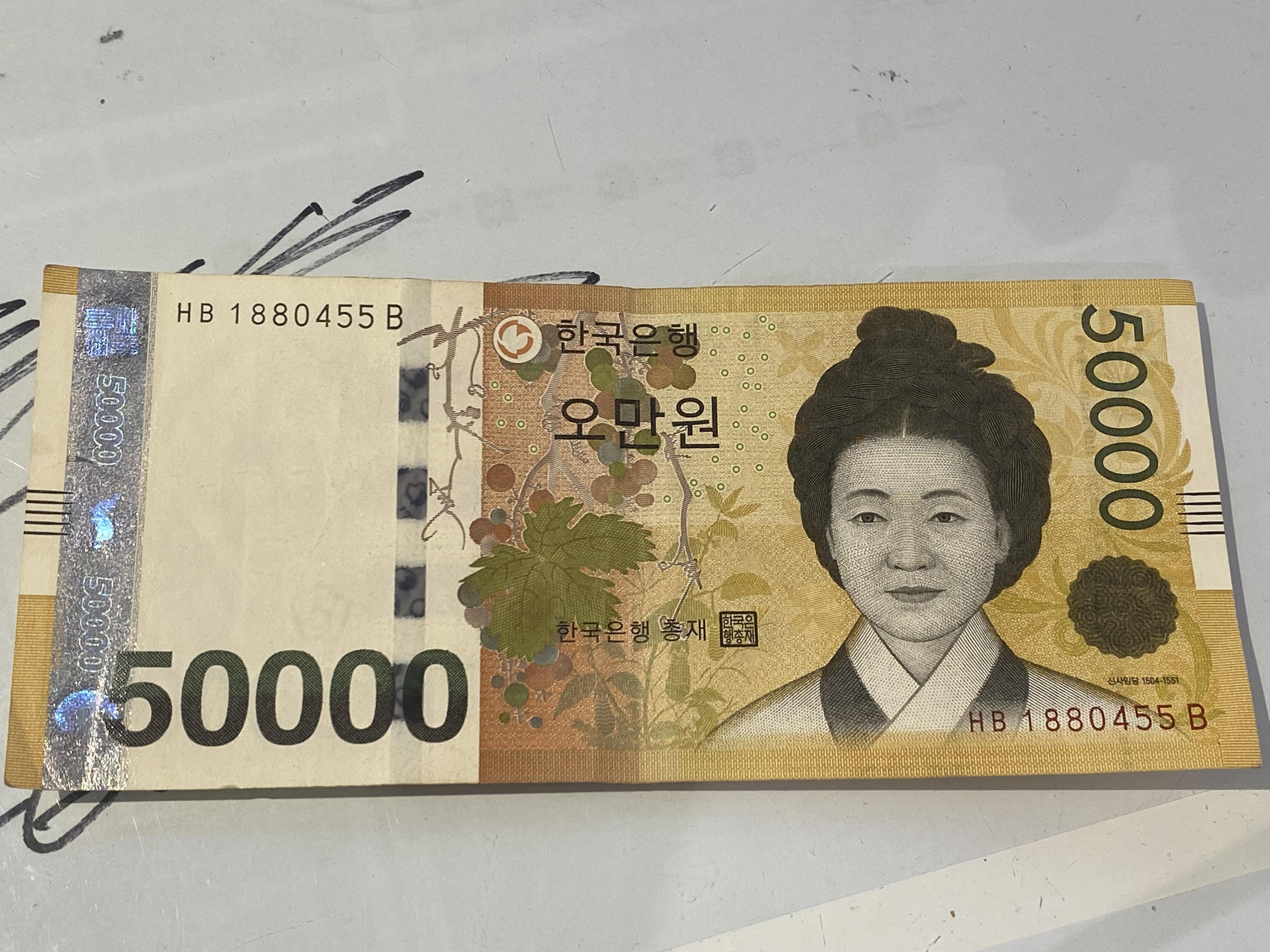
Before coming to Gangneung, I had already seen her countless times.
At convenience stores. In cafés. In the change from a taxi.
She had always been there, quietly printed on the 50,000-won note. I just never really looked.
Then, passing Ojukheon (오죽헌) in Gangneung, I suddenly realized:
this familiar face on one of Korea’s most recognizable banknotes came from here.
Ojukheon is not grand. Dark bamboo, old wooden buildings, low eaves, tucked away in a quiet corner of Gangneung. The wind moves softly through the bamboo, and time somehow seems to pass a little more slowly here.
Two people were born in this house: Shin Saimdang (신사임당), and her son, the scholar Yulgok Yi I.
Today, one appears on the 50,000-won note, the other on the 5,000-won note.
A mother and son, separated from us by centuries, somehow reunited inside the wallets of modern Korea.
There is something wonderfully charming about that.
Shin Saimdang lived during the Joseon Dynasty. She painted, wrote poetry, and practiced calligraphy. But her subjects were rarely kings, generals, or great historical scenes.
She painted grapes, flowers, insects, and birds.
Small things from an ordinary garden.
I like that about her.
Five hundred years ago, there were no cameras. If an insect landed on a leaf, or a cluster of grapes hung beneath a vine, the only way to preserve that moment was to really look at it—and then slowly place it onto paper, stroke by stroke.
Her son later became one of the most important Confucian scholars of the Joseon era. If his name feels unfamiliar, just pull out a 5,000-won note.
The mother is on 50,000 won.
The son is on 5,000.
A five-hundred-year-old family still lives neatly together in Korean wallets today.
And the mother happens to be worth ten times the son.
History, it seems, occasionally has a sense of humor.
But Shin Saimdang is remembered for more than raising a remarkable son. At a time when it was difficult for a woman to leave behind a name of her own, her paintings, poetry, and calligraphy survived.
In 2009, Korea placed her portrait on the newly issued 50,000-won note, making her the only woman featured on Korea’s current banknotes. Her grapes and insects appear there too.
Centuries ago, a woman painted a few blades of grass, a tiny insect, a cluster of grapes.
They never disappeared.
They remained with her, carried forward into the present, passing through people’s hands every day.
I never actually went inside Ojukheon.
I only passed by.
Strangely, that made me think about it even more.
Travel can be like that.
Some places you carefully explore and quickly forget. Others you never even enter, yet somehow they illuminate something familiar in an entirely new way.
She, too, once saw spring in Gangneung.
She saw the flowers in the courtyard.
Perhaps she once sat quietly in one of those rooms, bent over a page, painting a tiny insect.
Centuries passed.
The house remained.
The paintings remained.
And eventually, a country chose to place a woman who loved painting flowers, birds, grapes, and insects on its highest-denomination banknote.
Not a king.
Not a powerful official.
I like the warmth in that choice.
Now, whenever a 50,000-won note finds its way into my hand, I think I’ll look at it a little longer.
It is still the same banknote.
Only this time, I finally see her.