COLLECTED LIGHT · ORIGINAL STORY
What the World Cannot Take Away
Two things happened this week that, at first, seemed completely unrelated.
September 11 marked twenty-five years since 9/11.
And in Paris, Céline Dion walked back onto a concert stage.
Thirty thousand people had come to see a woman who had not completed a full concert in six years. When the music began, she was already in tears during the first song.
Then came “All By Myself.”
Everyone knew the note that was coming.
She hit it.
When it was over, she let out a long breath and turned toward her band, with a look that seemed to say:
I can’t believe I can still do this.
The entire arena rose to its feet.
Later, she told the crowd simply:
“Je vais bien.”
I’m doing fine.
And somehow, those three words brought thirty thousand people to tears.
Watching her, I suddenly thought of another group of people in the sky twenty-five years ago.
On September 11, 2001, I was in medical school.
I watched New York on television—the planes hitting the towers, smoke swallowing the streets. I was shocked. I couldn’t believe what I was seeing.
But years later, I would look back with some shame at how much of a spectator I had been.
I didn’t yet understand that the day would change the world.
After living in America for many years, I came to understand something else: behind every number in a tragedy is an entire human life—a parent, a spouse, a child, and a chair at the dinner table that will remain empty.
When we are young, suffering seems far away.
Eventually we learn that none of us really stands outside it.
Most of us remember the planes that struck America.
But I wonder how many people have ever asked:
What happened to all the other planes in the sky that day?
When the United States abruptly closed its airspace, flights already crossing the Atlantic suddenly had nowhere to go.
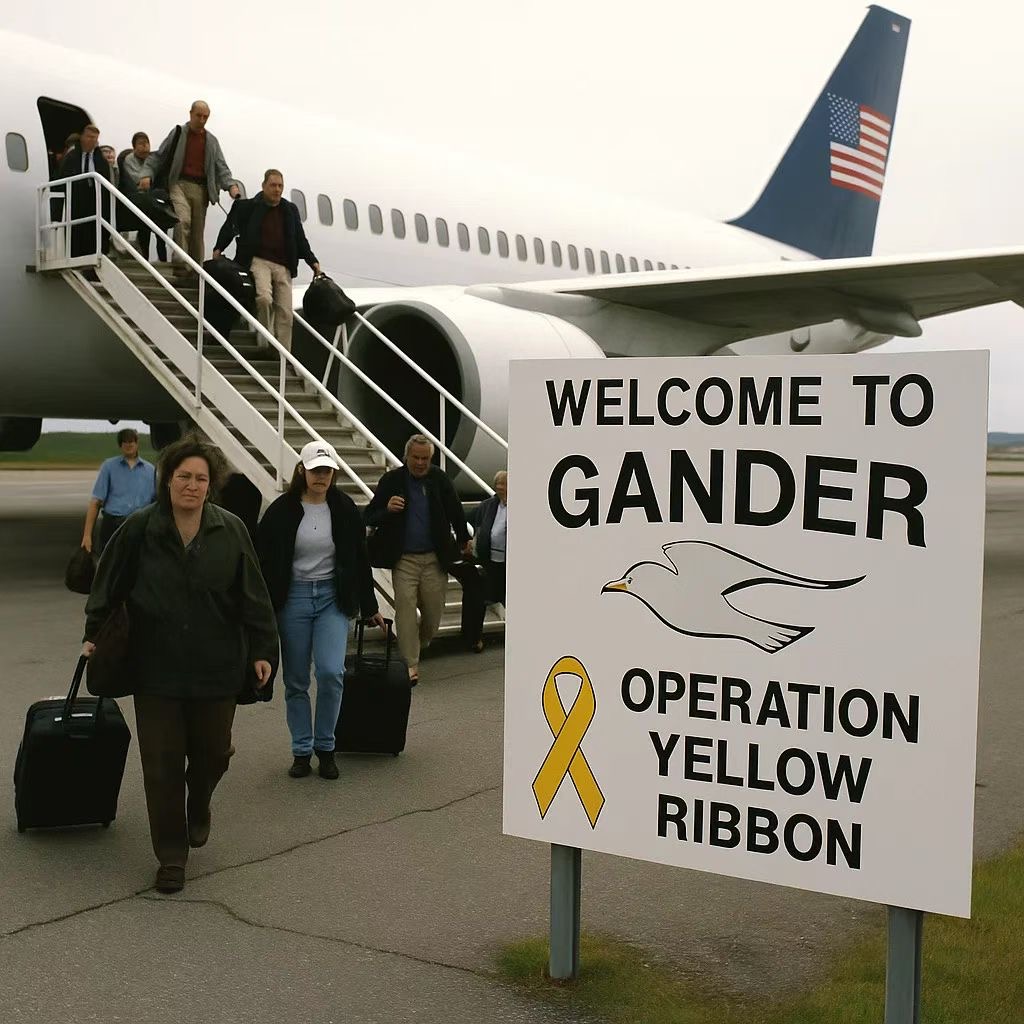
Canada launched Operation Yellow Ribbon, taking in more than 200 aircraft and over 30,000 stranded travelers.
Thirty-eight of those planes landed in Gander, Newfoundland.
Gander had a population of roughly 10,000.
And suddenly, 6,700 strangers fell out of the sky.
There were babies on those planes.
So people on the ground went to drugstores, bought formula and diapers, and brought them out to aircraft whose doors could not yet be opened.
The people of Gander were afraid too.
What if there were terrorists among these strangers?
They opened their doors anyway.
Schools closed and became shelters. Churches and community centers filled with mattresses. Even striking bus drivers returned to work, because thousands of people needed rides.
People ran out of medication; local pharmacies filled their prescriptions. Some passengers had not showered in days; families took complete strangers home.
The whole town started cooking.
There was so much food that the community ice rink became a giant refrigerator.
A town of ten thousand had suddenly grown by more than half.
And afterward, locals spoke about it as though they had done nothing remarkable.
Someone needed help.
So they helped.
Those few days eventually inspired the musical Come From Away.
But the story didn’t end when the planes left.
On one flight home, a passenger asked a simple question:
These people fed us, housed us, opened their homes to us—and refused to take our money.
What can we leave behind?
Someone had an idea:
Let’s help send their children to college.
A sheet of paper began making its way through the cabin.
Before the plane even landed, passengers had pledged $15,000. It became a scholarship fund that would help generations of local students continue their education.
Strangers had given them a home for a few days.
They gave the town’s children a piece of their future.
Years later, nearby Appleton received an extraordinary gift: a piece of steel from the ruins of the World Trade Center.
Steel left behind by one of humanity’s darkest acts traveled thousands of miles—not to commemorate hatred, but the kindness of strangers.
Some people had shown the world how cruel human beings could be.
On that very same day, others answered with a bed, a meal, a diaper, an open door:
This is how kind human beings can be.
I first discovered Céline Dion when I was in medical school.
Back then, I simply thought “My Heart Will Go On” was a beautiful song.
Later, I learned about the girl from Quebec, the youngest of fourteen children in a family of modest means, who somehow sang her way into an extraordinary life.
Then her husband, René, developed cancer.
At the height of her career, she stepped back to care for him. After he died in 2016, she eventually returned to the stage.
I saw her perform in Las Vegas during those years. She was standing so close to me.
Some singers, after enough years, stop being merely singers.
Their voices begin to carry pieces of your own youth.
Then Céline became seriously ill.
Stiff-person syndrome.
For a singer, there was something almost unbearably cruel about it. The disease can cause severe muscle rigidity and spasms and can interfere with the physical control required to sing.
A woman whose voice had changed her life was struck by an illness that threatened to take that very voice away.
She disappeared from full concerts for six years.
Many assumed she would never return.
But she kept working.
She retrained her body. Her breathing. Her voice.
Day after day.
Until this September, when she walked back onto a stage in Paris.
Twenty-five songs.
More than two hours.
And the woman who had once faced the possibility of losing her voice sang “My Heart Will Go On” again.
Twenty-five years ago, when I first heard that song, I thought it was about love.
Now I hear something else.
It is also about what happens after loss—when people leave, when things are taken from us, when life can never return to what it was.
And yet, somehow, the heart goes on.
I became Canadian, and later American.
So Canada and the United States have never been simply two neighboring countries on a map to me. Both became home. My feelings for both come from having lived a life in each.
Last September, I experienced reunion and separation.
This September brought a final goodbye.
And still, I choose to believe in certain things.
Because I have seen a small town open its doors when strangers had nowhere else to go.
And I have seen a woman who nearly lost her voice walk back onto a stage six years later and sing the note everyone thought she might never sing again.
We grow old.
People leave.
Many things we once believed we could never lose, we eventually do.
Perhaps what is most precious about being human is not what we manage to hold on to.
It is knowing how fragile life is, and still offering a stranger a bed.
Having so much taken from us, and still finding another song to sing.
Being hurt, and still refusing to lose our capacity to love.
Twenty-five years ago, Gander opened a door.
Twenty-five years later, a light came on in Paris.
We have been hurt, and still choose kindness. We have lost, and still choose love. We know how every story ends, and still choose to keep moving forward.
Maybe that is what it has meant all along:
My Heart Will Go On.