COLLECTED LIGHT · ORIGINAL STORY
It Had Been There All Along
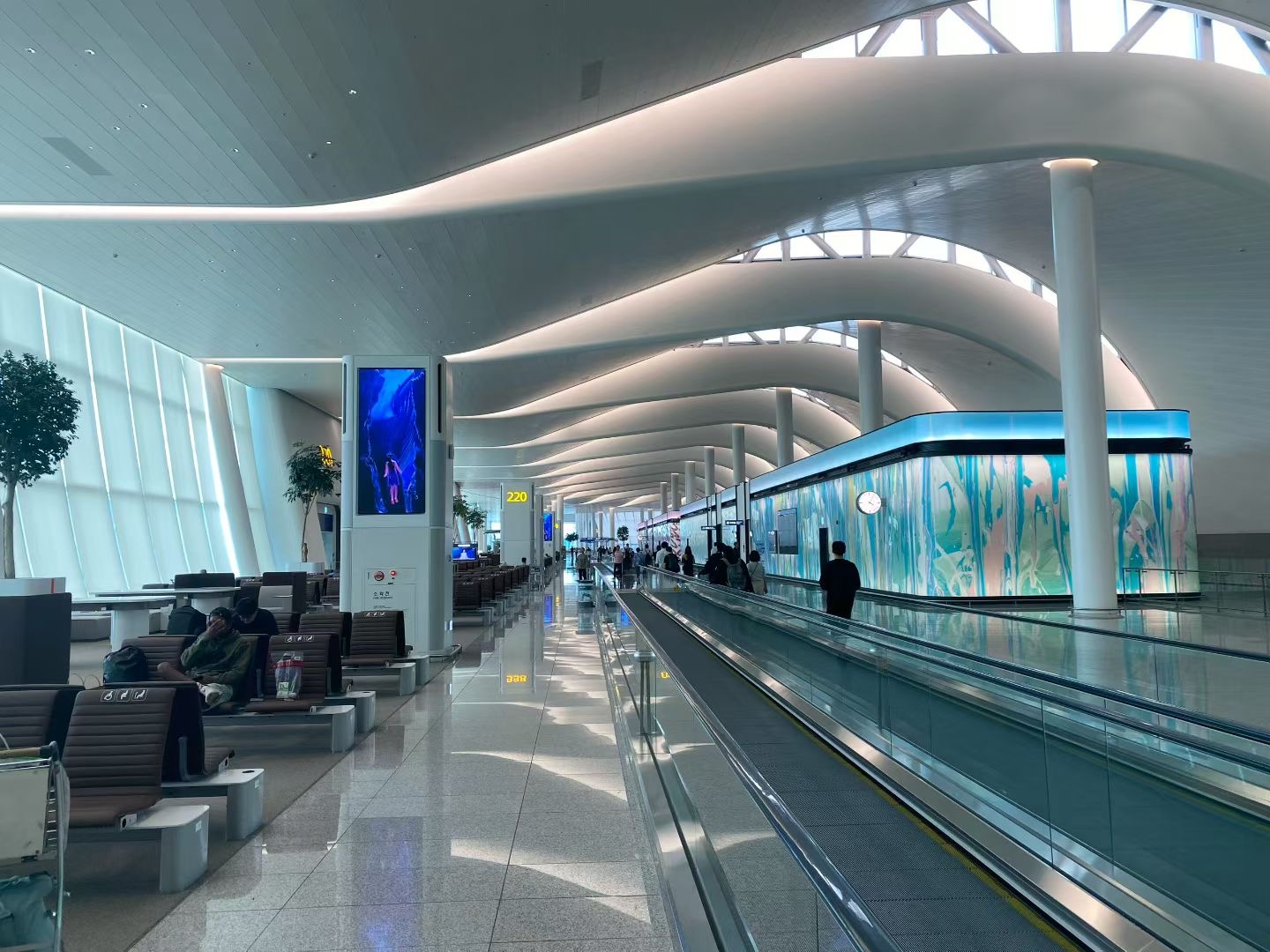
On the same day in late September, I found myself at Incheon Airport again.
Last time, I was here to see off an old friend I had reunited with after many years.
This time, I was the one leaving.
On my way to work this morning, I noticed that the first leaves had already begun to fall.
There was nothing remarkable about the one at my feet. I didn’t even know which tree it had fallen from.
I had walked past that spot every day all summer. Seoul summers can be relentless, and perhaps on some morning or afternoon, that leaf had shielded me from the sun for a fleeting moment. In a way, it had been there with me all summer.
Yet I had never once looked up at it.
Only now, in early autumn, after it had let go of the branch and fallen at my feet, did I really see it for the first time.
Perhaps we are all like that.
Some things are there for so long that they simply become part of the background of our lives. Only when their place is suddenly empty do we realize how much space they once occupied within us.
When I was a child, my grandmother adored me.
Every Saturday night, I would be too excited to sleep because the next morning I got to go to her house and be the little boy who could get away with absolutely anything.
Once, I casually mentioned that the other kids all had jianzi—the little feathered shuttlecocks we kicked around as children.
I forgot about it almost immediately.
She didn’t.
When I was nine, my grandmother, who lived alone, passed away suddenly.
When she died, she was still holding an unfinished jianzi in her hand.
The moment I saw it, I remembered what I had said.
A passing remark from a child had somehow become an assignment I had unknowingly left for her.
She never got to finish it.
I shook her hand and called out to her, over and over, but she no longer answered.
Later, one of the adults handed me a small shovel and told me that the ashes in front of me were my grandmother.
That was the first time I understood what it really meant when someone was “gone.”
It didn’t mean they weren’t here today.
It didn’t mean they would come back in a few days.
It meant they would never come back.
Decades have passed, but I still remember that moment with extraordinary clarity. And even now, I often dream of her.
In my dreams, she is exactly as she used to be, as though she had never left.
I ask her, “If you’ve been here all along, why haven’t you come to see me?
Why have you been hiding from me?”
She never answers.
She simply looks at me quietly, her eyes full of love.
And then I wake up.
In the darkened room, there is only silence—
and a pillow wet with tears.
This summer, while traveling through Hokkaido, I walked into a little shop in Otaru and saw four Japanese characters on the door:
Ichigo ichie.
“One time, one meeting.”
I had known the phrase for years. But that day, for some reason, it suddenly became real.
I remember thinking that I would probably never walk into that little shop again.
Even if I returned to Otaru many years from now, the street might still be there, the doorway might still be there, but the person who greeted me so warmly that day probably wouldn’t be.
And even if they were, I would no longer be the person I was that day.
Places can be revisited.
Time cannot.
Along the way, I passed places that felt strangely familiar: railway tracks beside the sea, the ocean appearing at the end of a sloping street, a quiet corner I somehow felt I had seen before.
Then I remembered.
I had seen them in animation.
Long before I arrived, perhaps an artist had once stood in that same place, in another season and another kind of light, and captured one fleeting moment of what was before them.
Years later, I arrived there from an entirely different life.
We had never met. We hadn’t even existed in that place at the same moment.
And yet, our eyes had rested on the same sea, the same street.
As if we had missed each other in time, only to meet again in another dimension.
When you think about it, the odds of two people ever meeting are astonishingly small.
First, you have to be alive in the same era.
Then you have to find yourselves in the same city.
And even then, you have to pass through the same place at the same time.
If you somehow start talking, share a meal, laugh together, become friends, and end up occupying even a small chapter of each other’s lives—
that already feels a little like winning the lottery.
The strange thing is, when we win, we usually don’t know it.
While working in Korea, I often told my colleagues that performance matters. KPIs matter. Numbers matter.
But a month from now, a year from now, you probably won’t remember most of them.
What you will remember are the people.
You will remember who helped you when you were exhausted. Who hurt you. Who truly listened when you needed to be heard. And you will remember how you treated one another.
Those things can stay with us for years.
So I often tell my team: come to work with some joy.
Because one day, we will all go our separate ways.
Someone will change teams. Someone will change companies. Someone will move to another country.
The person sitting beside you today—the one you meet with, have lunch with, complain and laugh with—may, a few years from now, become someone you can barely find an opportunity to see.
Org charts will change.
Today’s numbers will be replaced by tomorrow’s.
But in this enormous world, somehow, for a few years, we happened to walk into the same building every morning.
That, too, is ichigo ichie.
The airport announcement sounds again.
Some people are arriving. Some are leaving. Some are waving goodbye. Others are pulling their suitcases toward the gate.
Last time I stood here, I watched someone leave.
This time, it is my turn.
We rarely know which time will be the last time.
The last time you have dinner together, the food is still warm.
The last time you say goodbye, you probably just say, “See you next time.”
No one taps you on the shoulder and tells you:
This is the final scene the two of you will ever share.
So if there is no next time, that doesn’t make what came before any less real.
Celebrate every friendship.
Celebrate the roads you walked together, the meals you shared, the ridiculous conversations that meant nothing and somehow meant everything.
Celebrate the people whose lives, for one brief moment in the vastness of time and space, happened to overlap with yours.
Not every journey has to last until the end for the meeting to have been worthwhile.
Before boarding, I thought again about the fallen leaf I had seen that morning.
All summer long, I had never once looked up at it.
Only after it fell did I finally stop and really see it.
It had been there all along.